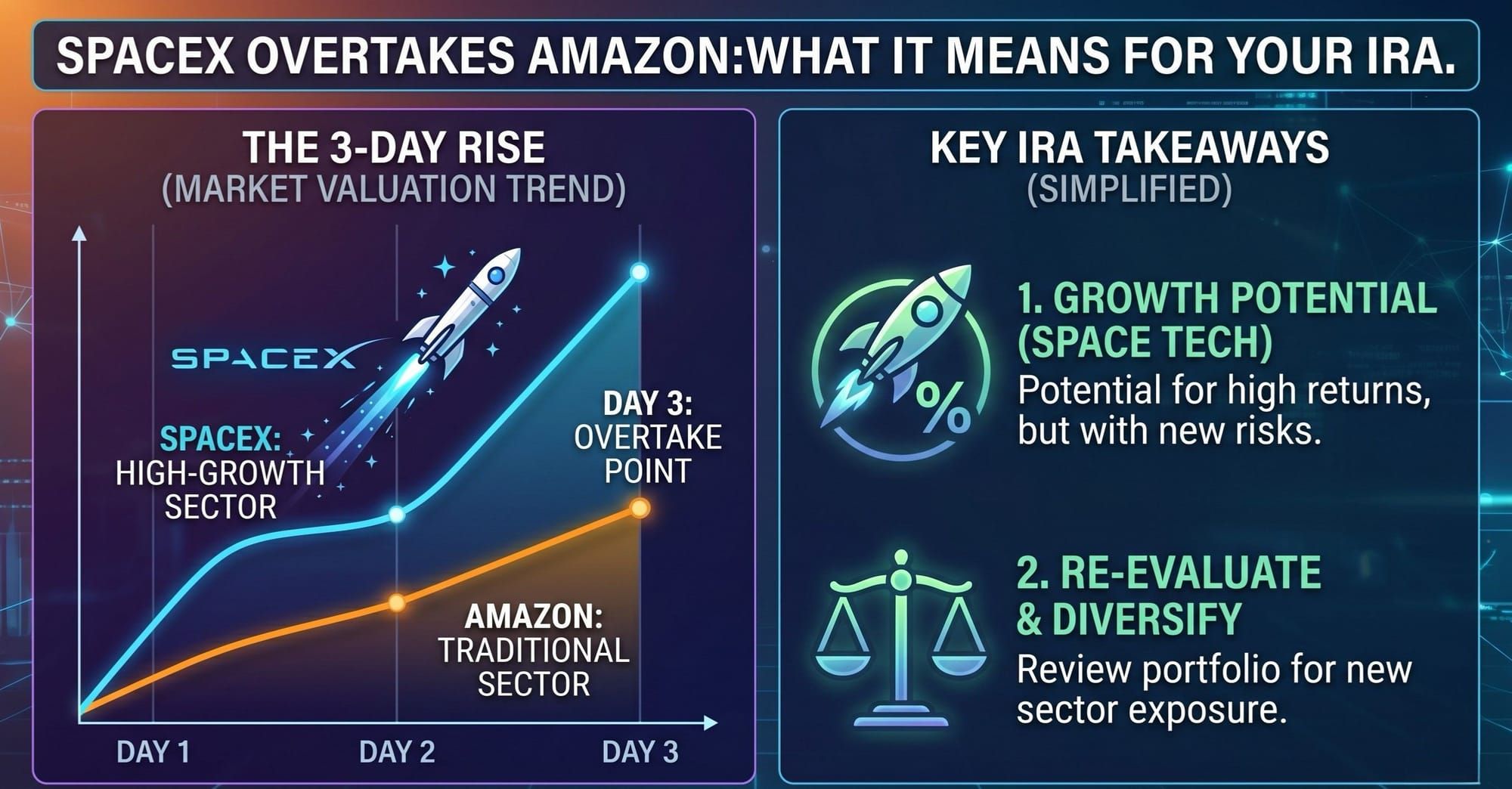

I was standing in the warehouse break room this morning pouring black coffee when a driver pointed at the wall-mounted TV. SpaceX stock was up another 14%. The ticker showed a market cap north of $2.85 trillion. He whistled. I didn't.
Here's why. Amazon made $78 billion in profit last year on $717 billion in sales. SpaceX lost $4.9 billion on $18.7 billion in revenue. Yet SpaceX is now valued higher than Amazon. That's not investing. That's a fever dream with a brokerage account.
This matters to you. Not because you're buying SpaceX shares directly. But because the funds inside your 401(k) and IRA are likely already doing it for you — quietly, automatically, and without asking permission. Today we audit that exposure, decode the hype, and hand you a concrete action step.
The Inefficiency Leak: How a $1 Trillion Valuation Spike Happens in 72 Hours
Let's walk through the chain. SpaceX went public Friday at roughly $1.7 trillion. By Tuesday morning it touched $2.95 trillion. That's a $1.25 trillion increase in three trading days. Over 62% above the $135 IPO price.
Here's the flowchart of what actually happened:
SpaceX IPO at $135/share (~$1.7T valuation) → Compute leasing deals with Anthropic & Google announced → $60B stock-only acquisition of AI startup Cursor → Hype cycle ignites → Stock hits $220/share → Valuation balloons to ~$2.85T
Now run the BS Meter on this. SpaceX reported a $4.9 billion loss against $18.7 billion in revenue last year. Amazon, the company it just leapfrogged, generated $78 billion in actual profit. Microsoft, which SpaceX briefly surpassed at $2.92 trillion, prints money every single quarter.
Morningstar analyst Nicolas Owens initiated coverage and pegged SpaceX's fair value at approximately $780 billion. That's less than half of the IPO valuation and roughly 27 cents on the dollar of today's price. Fast Company reported that "numerous analysts on Wall Street have cautioned investors about the possibility that the company's valuation may be artificially inflated."
That gap between $780 billion in estimated fair value and $2.85 trillion in market price? That's not growth potential. That's a $2 trillion cushion of pure speculation sitting inside the funds that hold your retirement savings.
The Straits Times confirmed SpaceX "briefly topped Microsoft's valuation of $2.92 trillion." Bloomberg reported the valuation "approached $3 trillion" at peak. Reuters noted the surge "significantly contributed to the rise of the Nasdaq Composite index." Every major index fund tracking the Nasdaq just got heavier with SpaceX exposure. Your account likely did too.
The Arbitrage Alert: Where Your 401(k) Gets Quietly Siphoned
Here's where Wall Street quietly siphons away your hard-earned money. It's not one big theft. It's a series of small, legal, automatic moves.
When a stock like SpaceX enters major indices, fund managers must buy it. They don't have a choice. Your S&P-adjacent or Nasdaq-tracking fund rebalances. New shares get purchased at inflated prices. You pay the management fee on those inflated holdings. If the stock corrects — and a $2 trillion gap between price and fair value suggests it might — your balance absorbs the loss. The fund manager still collects the fee.
Let me map that for you:
SpaceX enters index → Your fund auto-buys at $220/share → Fund expense ratio charges you on inflated position → Stock corrects toward $780B fair value → Your balance drops → Fund manager still gets paid
This is not conspiracy. This is mechanics. This is how passive index investing works when a speculative rocket ship gets bolted onto the same track as your retirement savings.
The real danger isn't SpaceX itself. It's concentration risk you didn't choose. If your target-date fund or growth fund now carries 3-5% in a company that lost $4.9 billion last year, that's a decision someone made with your money. You weren't consulted.
And the fees compound the problem. Every dollar of inflated valuation inside your fund increases the base your expense ratio charges against. A 0.75% fee on a $300,000 account is $2,250 a year. If 4% of that account is overvalued SpaceX exposure, you're paying fees on air.
Money Move of the Week: Audit Your Fund's SpaceX Exposure in 15 Minutes
Stop guessing. Open your 401(k) or IRA statement and run this checklist tonight.
Step 1: Log into your account. Pull up your current fund holdings. Look for any fund with "Growth," "Technology," "Nasdaq," or "Total Market" in the name.
Step 2: Click into each fund's top-10 holdings. Most providers list these on the fund detail page. Search for SpaceX. Note the percentage weighting.
Step 3: Check the fund's expense ratio. Write it down next to the SpaceX weighting. Multiply your total balance in that fund by the expense ratio. That's your annual fee in real dollars.
Step 4: If SpaceX appears in your top-10 holdings at more than 2%, call your plan administrator or advisor. Ask this exact question: *"What is my current concentration in SpaceX, and what is the fund's rebalancing policy if the stock corrects by 30% or more?"*
Step 5: Request a written breakdown of all funds in your account that hold SpaceX. Compare the total exposure across all funds. If combined SpaceX weighting exceeds 5% of your total retirement balance, ask about reallocation options with lower single-stock concentration.
Write down every answer. If your advisor can't answer in plain English, that tells you everything.
Morningstar says fair value is $780 billion. The market says $2.85 trillion. That gap is not your problem to finance. Audit your exposure. Ask the hard questions. Protect the money you spent decades earning.