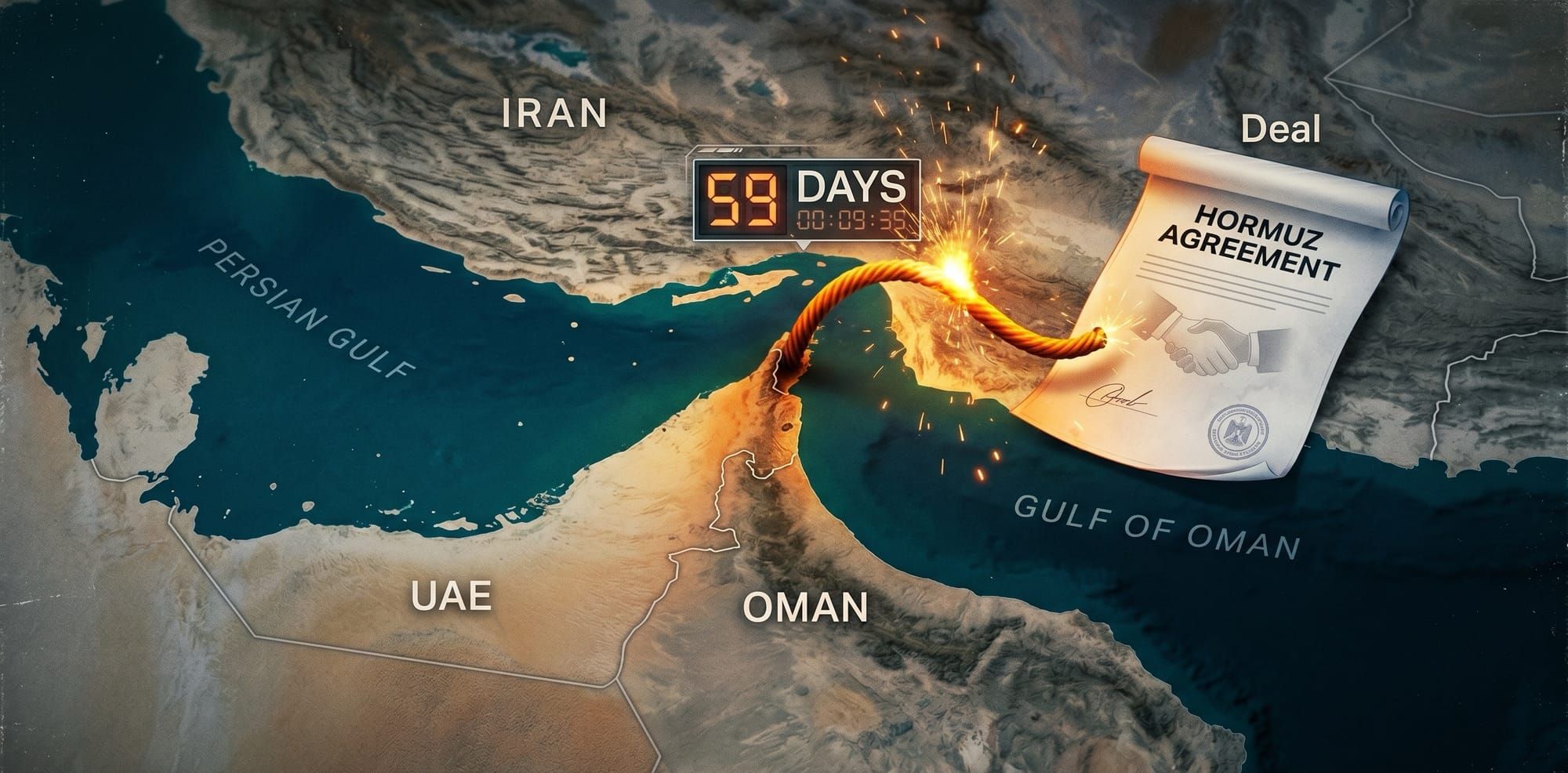

The U.S. and Iran signed a memo of understanding this weekend. Both sides agree the Strait of Hormuz — a 21-mile-wide chokepoint carrying roughly 20% of the world's oil — reopens toll-free. Both sides agree that lasts 60 days.
After that? The two governments are telling totally opposite stories about what comes next.
That gap is the single biggest risk sitting between you and your energy-linked retirement holdings right now.
The Inefficiency Leak: One Deal, Two Translations, Zero Clarity
Let's lay out the facts side by side. They're ugly.
What Washington says: Trump posted on Truth Social that the Strait of Hormuz will be "permanently toll-free." A senior U.S. official told reporters Monday they are "quite clear" the toll-free setup will carry into the final deal. Trump told The New York Times the deal ensures free passage forever.
What Tehran says: Iran's state-linked Fars News Agency reported the deal "explicitly recognises" Iran and Oman's control over strait services. Their source said it plainly: "America has accepted the idea of charging fees and has merely gotten a 60-day discount from Iran." Iran's Foreign Minister Araghchi told state TV that Iran keeps control. It will charge for "services provided." Iran has already started building a "Persian Gulf Strait Authority" with Oman.
Read those two sections again. They cannot both be true.
The full text of the deal has not been released. U.S. officials promised it within 24–48 hours. Until that paper is public, we're running on press conference promises and state media spin.
Here's my BS Meter reading: pegged at 8 out of 10. When two parties sign the same paper and right away clash on its core point, somebody is managing the story. And when the story gets managed, regular people holding energy-linked assets pay the tab.
The supply chain math is dead simple:
Strait tolls imposed → tanker costs rise → crude shipping fees spike → refinery input costs climb → diesel and gas prices jump → consumer prices re-speed → Fed holds rates higher → bond values in your 401(k) stay crushed
That's not guesswork. That's a freight bill with extra steps.
The Arbitrage Alert: What 60 Days of Doubt Does to Your Retirement Holdings
Let's talk about what's really inside your retirement account. This is where the Hormuz clash lands on your kitchen table.
Most target-date funds inside 401(k) plans carry 5–15% exposure to energy stocks and commodity-linked bonds. If you're in a 2030 or 2035 target-date fund, you almost surely own pieces of big oil companies, pipeline firms, and energy property trusts. Those holdings just got a 60-day window of hope — followed by a cliff of doubt.
Energy markets rallied on the deal news. That makes sense. Reopening the strait and lifting the naval blockade means tankers move again. A senior U.S. official estimated shipping traffic "will return to normal fairly quickly, certainly within 30 days, once all the mines are cleared." Crude flowing means downward push on oil prices. Good for buyers. Good for prices. Good for the Fed's rate path.
But here's the leak nobody's plugging.
Iran has said on the record it plans to "benefit from the financial proceeds of commercial ships transiting this strait" after the 60-day window. They're framing it as payment for "safety, navigation, environmental, and insurance services." That's not a toll. That's a toll wearing a hard hat and a safety vest.
If those fees show up — even small ones — the cost hike hits fast:
Strait service fees → +$0.50–$2.00/barrel shipping cost → global crude price shift → U.S. refinery squeeze or consumer price bump → inflation outlook shifts → Treasury yields react → bond fund values inside your IRA move
Every single link in that chain touches your statement. Your fund manager won't call to explain it. They'll just quietly shift things around and charge you the fee for the favor.
Meanwhile, Trump warned in his New York Times interview that if Iran fails to reach a final nuclear deal, he would either restart strikes or act as "guardian of the Middle East" in exchange for 20% of the region's income. That's not a calming statement. That's a second layer of risk baked into every barrel.
The nuclear talks haven't even started yet. Those "technical talks" begin Friday in Switzerland. Iran holds 12 tonnes of enriched nuclear fuel. The U.S. wants it diluted and removed. Iran hasn't publicly agreed to that.
Pakistani Prime Minister Sharif confirmed both sides declared "immediate and permanent termination of military operations on all fronts, including in Lebanon." That's progress. But progress and a signed final deal are two very different animals.
Money Move of the Week: The 60-Day Energy Exposure Audit
You have exactly 60 days before this situation resolves or blows up. Use them. Here's your step-by-step audit. Print this out. Do it this week.
Step 1: Pull your most recent 401(k) or IRA quarterly statement. Look for the holdings page — not the summary. Find the actual fund list with ticker symbols.
Step 2: Find your target-date fund or balanced fund. Google the ticker symbol plus "holdings" or "fact sheet." Download the PDF. Look for the sector breakdown chart.
Step 3: Find your energy exposure percent. Write it down. If it's above 10%, circle it. That's your Hormuz risk number.
Step 4: Check the expense ratio on that same fact sheet. If it's above 0.50%, you're paying extra to hold risk you may not want. Write that number next to the energy percent.
Step 5: Call your plan admin or advisor this week. Use this exact question: "What is my current energy sector exposure across all holdings, and what is the total blended expense ratio I'm paying? I want both numbers in writing by email."
If they can't answer that in 48 hours, you have the wrong advisor.
Step 6: Decide your comfort level. If you're within five years of retiring and carry more than 10% energy exposure, ask your advisor to model a shift. Not a panic sell. A scenario on paper. Compare it to your current setup. Then decide with data, not headlines.
The Hormuz situation will either settle into free transit for good — which is great for energy prices and your savings — or it will turn into a fee system that adds cost to every barrel of crude moving through that chokepoint.
You don't need to predict which outcome wins. You need to know exactly what you're holding before either one hits.
Dale at pump eight doesn't have a Bloomberg screen. Neither do you. But you have a statement, a phone, and 60 days. That's enough.