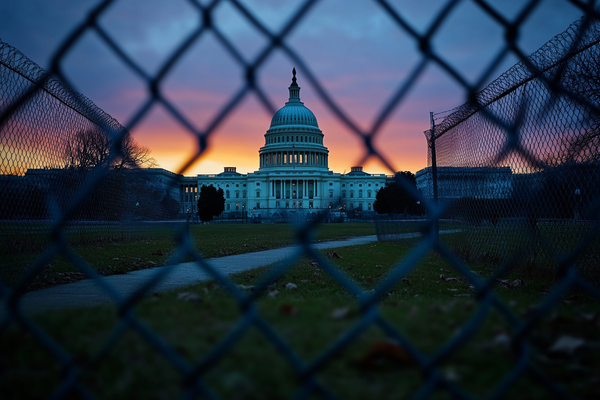
Last week, a 927-page financial disclosure dropped on Capitol Hill. It revealed over $2.2 billion in assets and income. Crucially, more than $1.2 billion originated from digital assets connected directly to the executive branch.
To a regular guy, it looks like a standard political headline. To an old corporate auditor like me, it looks like a massive freight train with broken brakes.
Let’s cut through the media noise. Here is my straight-shooting, follow-the-money analysis of Washington's incoming structural storm.
This law paints an ugly picture for American retirement accounts.
Here's an example:
You're a 62-year-old who has put money away all your life.
You've done so to secure a comfortable retirement, on your own terms.
But you also want to pass your retirement savings balance to your loved ones.
This includes your 401(k)s… traditional IRAs… even your Roth IRAs.
The Investigative Engine Gains an Explicit Roadmap
In my three decades managing complex supply chains, an unexpectedly dense, late-filed shipping manifest meant one clear thing. Someone upstream was scrambling to manage an unrecorded liability or a massive inventory leak.
The 927-page disclosure operates under the exact same structural logic. House Democrats are already treating this dense paper trail as a ready-made tactical map for aggressive corporate oversight.
Representative Jamie Raskin is already organizing specific committee targets for the upcoming legislative session. The primary focus will land heavily on corporate funding channels, conflict-of-interest loopholes, and public fund waste.
On the defensive side, the alarms are ringing just as loudly. House Speaker Mike Johnson publicly warned corporate donors that opposition lawmakers intend to turn multiple congressional committees into highly aggressive investigative units.
Meanwhile, the prediction markets are pricing in an unprecedented structural shift. Current tracking data on Kalshi places the probability of a House leadership flip at a staggering 82%.
This is no longer a speculative political coin toss. An 82% probability is a hard metric that forces major corporations to completely alter their compliance strategies.
In case you missed it...
...make sure you get your "Simple Options Trading For Beginners" book before your link expires.
I eventually plan to charge money for this training, so do yourself a favor and download it now...
Simple Options Trading For Beginners
Running the BS-Meter on K Street's Defensive Rebalancing
Let’s run this entire Washington situation straight through our corporate BS-Meter. The mainstream talking heads keep calling this routine election-year bickering. That narrative is pure fiction.
To find the ground truth, you must ignore the speeches and track where the capital is moving. Top-tier corporate lobbying firms are expanding their congressional investigation defense practices at record speed.
Major corporate defense firms do not build out massive new legal infrastructures without an immediate, burning commercial necessity. They are actively preparing for an unprecedented surge in federal records requests.
Look at the recent talent migration registries. Elite firms are aggressively snapping up top Democratic committee aides and former federal oversight specialists.
For instance, major law firms are recruiting heavily from federal agency ranks. Former FBI oversight pros like Megan Greer and Anna Uhls just moved to private K Street practices.
Simultaneously, Akin Gump brought on Marcus Childress, the former senior advisor and special counsel to the House Judiciary Committee. These are not routine corporate compliance hires.
These are high-cost, wartime defense strategies. Corporate America is quietly pouring millions into legal infrastructure because they know a tidal wave of subpoenas is coming in early 2027.
The operational chain reaction is moving through four distinct phases:
House Leadership Flips (82% Odds) → Committees Weaponize Maps → Subpoenas Issued Q1 2027 → Corporate Compliance Costs Skyrocket
The 30-Day Macro Scope: Chronology of an Escalation
This impending corporate gridlock did not materialize overnight. To understand how the regulatory landscape reached this sudden bottleneck, we must trace the steady, 30-day build-up.
One month ago, the broader regulatory environment appeared relatively stable. Corporate interests and institutional analysts were anticipating highly predictable, quiet legislative paths through the remaining summer months.
However, hidden friction began mounting rapidly behind closed doors exactly three weeks ago. Opposition lawmakers quietly began drafting preliminary records requests specifically targeting executive digital asset holdings and infrastructure contracts.
The sudden public release of the 927-page document acted as a massive, high-octane accelerant on July 7th. It instantly transformed a generalized political dispute into a data-backed, highly focused corporate campaign.
This cumulative 30-day escalation has completely removed the standard summer buffer from the market. The political risk premium is no longer a distant, abstract variable for late autumn.
It has integrated directly into current market volatility indices. Major institutional players are actively repositioning their capital to shield against the opening volleys of this committee war.
Sector Volatility and Key Operational Markers
The structural conclusion of this month-long shift is completely undeniable. The domestic corporate landscape is entering a prolonged period of rolling headline risk and operational friction.
Certain highly exposed sectors will take the heaviest, most direct hits from this investigative blitz. The digital asset, fintech, and federal infrastructure contracting spaces sit directly in the crosshairs due to the specific nature of the disclosed funds.
Any sudden, televised committee hearing will trigger instant, automated algorithmic selling across these specific equity blocks. Institutional investors hate regulatory ambiguity, and Washington is about to manufacture it in bulk.
As an auditor, I advise tracking three critical operational indicators over the coming weeks rather than watching political commentary:
- The resumption of formal committee schedules after July 9th: This will dictate the exact speed and trajectory of the initial document requests.
- Subpoena defense spending metrics among Fortune 500 firms: This is the truest leading indicator of actual corporate legal exposure.
- The Federal Regulatory Uncertainty Index: Sharp upward moves here historically precede major downturns in corporate capital expenditure.
Politicians will continue to use beautiful, highly spun slogans to rally their respective bases as November approaches. But the real structural data remains buried in committee dockets and K Street hiring registries.