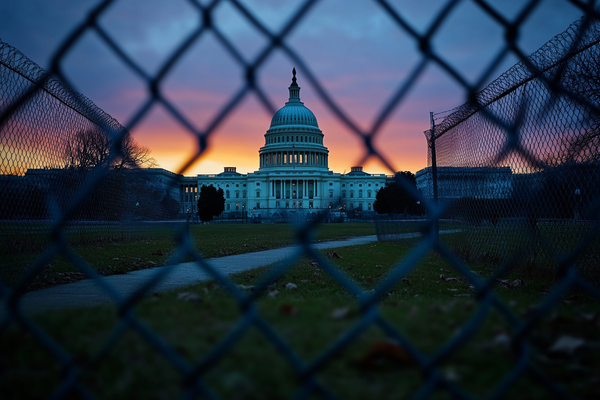
Last week, an experienced procurement manager at an industrial plant off Route 9 asked me a direct question. He looked at the federal contract pipelines and shook his head.
"Arthur, what happens to our supply chain projections when the people steering the national budget are suddenly removed from the floor?"
He was not talking about partisan politics. He was looking at downstream logistics capacity and procurement timelines.
Senator Lindsey Graham passed away due to an unexpected aortic dissection at age 71, immediately following a high-profile diplomatic meeting in Kyiv. He served as the chairman of the Senate Budget Committee.
Concurrently, former Senate leader Mitch McConnell remains sidelined in a rehabilitation facility following a severe fall and a prolonged bout with pneumonia.
Two heavyweight legislators, both holding vital seats on the Senate Appropriations Committee, are suddenly unavailable. Washington returns to active session facing a looming government funding deadline, an unresolved attorney general confirmation, and a highly contested defense spending package.
Let's bypass the cable news theater. Here is a straight-shooting, data-backed macro analysis of how this legislative power vacuum shifts real-world operational timelines.
How Texas Will Become a Lithium Powerhouse
Texas just made history. EnergyX commissioned the largest lithium production demo facility of its kind in the state, and they're just getting started.
America needs 5X more lithium by 2040. But supply deficits are already forming, with Morgan Stanley projecting an 80K-ton shortage this year alone. So oil giants like Exxon and Chevron have been buying up land in Texas, America’s emerging lithium hotspot.
EnergyX's patented technology produces up to 3X more lithium than conventional methods at 500X the speed. Not only that, they have rights to nearly 50,000 acres of lithium-rich Texas land with 3M+ untapped tons, part of a global portfolio with up to 15M+ tons.
This isn't a concept. The facility is live, producing lithium today. General Motors, POSCO, Eni, and 50,000+ investors have already backed them.
Early-stage shares are still open ahead of full commercial scale. Invest in EnergyX by July 16.
Disclaimer: Energy Exploration Technologies, Inc. (“EnergyX”) has engaged Dynamic Industries to publish this communication in connection with EnergyX’s ongoing Regulation A offering. Dynamic Industries has been paid in cash and may receive additional compensation. Dynamic Industries and/or its affiliates do not currently hold securities of EnergyX. This compensation and any current or future ownership interest could create a conflict of interest. Please consider this disclosure alongside EnergyX’s offering materials. EnergyX’s Regulation A offering has been qualified by the SEC. Offers and sales may be made only by means of the qualified offering circular. Before investing, carefully review the offering circular, including the risk factors. The offering circular is available at invest.energyx.com. Comparisons to other companies are for informational purposes only and should not imply similar results.
The Budget Blueprint Engine Grinds to a Halt
The mechanical reality of a congressional committee freeze is highly predictable. A sudden loss of leadership within the primary spending committees instantly creates a legislative bottleneck.
Senator Graham was under immense pressure to advance a comprehensive budget package containing heavily expanded defense allocations. With his passing, that institutional momentum stops cold.
A new chairperson must be formally appointed, organized, and briefed on complex, multi-billion-dollar line items. This transition process will realistically drain weeks from an already compressed legislative calendar.
Senator McConnell’s prolonged absence compounds this operational friction. He occupies a senior seat on the Appropriations Committee, which physically controls the federal spending checks.
His office recently confirmed that while he is recovering, he cannot return to active floor duties immediately. The Senate must now operate with a razor-thin 53-47 Republican margin, giving dissenting factions outsized leverage.
This sudden structural vacuum leaves the remaining body short-staffed and ill-equipped to meet upcoming deadlines. The immediate operational chain reaction moves through a clear sequence:
Committee Vacuums → Budget Deadlines Missed → Continuing Resolutions Issued → Federal Procurement Halts
This gridlock is highly inefficient. When government procurement freezes, major defense and infrastructure contractors delay their secondary supplier orders, causing a quiet backlog throughout the industrial sector.
Trump just replaced the U.S. dollar.
Something far more consequential.
It's already signed. More than 60 nations are already committed.
And the last time America did something like this — it created a thousand new millionaires every single day for 50 years.
Click here to see what comes next — and how to position yourself →
The 30-Day Macro Scope: How the Conflict Escalated
This legislative gridlock did not develop overnight. To understand how the federal budget process reached this sudden chokepoint, we must track the steady, 30-day buildup.
One month ago, domestic infrastructure contractors and logistical planners operated under the assumption of stable fiscal appropriations. The legislative path toward late-summer funding looked highly predictable.
Two weeks ago, hidden friction broke out into the open regarding the scale of domestic energy subsidies and foreign defense packages. Bipartisan negotiations grew tense, but leadership structures remained fully intact.
The sudden removal of both the Budget Chairman and a senior Appropriations lead completely shattered that fragile equilibrium. It turned a routine budget debate into an unprecedented structural standstill.
This cumulative 30-day escalation has effectively eliminated the standard summer buffer window. Government agencies are suddenly forced to prepare for rolling continuing resolutions, which freezes long-term capital expenditure across the defense and transport sectors.
Trump’s Secret Plan to End the Ukraine War: What It Means for America
Donald Trump is making headlines with a bold promise to end the Ukraine war. With high stakes and tensions rising, his move could change everything for America.
What’s behind this unexpected strategy, and how will it impact the future?
The Sanctions Matrix: Energy Disruptions by Design
Before his passing, Senator Graham announced a major bipartisan agreement alongside Senators Blumenthal, Shaheen, and Wicker on a sweeping Russia sanctions package.
The proposed legislation is designed to levy aggressive tariffs on third-party nations continuing to purchase Russian crude oil. This is an intentional global energy supply chain disruption.
The physical flowchart of this policy moves through specific industrial channels:
Sanctions Legislation Passes → Global Crude Pools Contract → Diesel Refiners Pay Premium → Domestic Freight Surcharges Jump
Despite the current leadership vacuum, this bill carries intense emotional and political momentum. House representatives have pledged to introduce identical companion versions, making eventual passage highly probable.
For operators in the real economy, this means preparing for immediate input cost inflation. Diesel prices are already running above seasonal averages across major shipping corridors.
If this sanctions package constricts global crude flows even modestly, refining margins will tighten further. This will drive commercial fuel costs up within the next sixty days.
Long-Term Industrial Risks and Leading Indicators
The structural conclusion of this month-long shift points to a prolonged period of operational uncertainty. A short-staffed Senate cannot efficiently process complex trade and spending legislation.
Four primary macro arenas face significant friction moving forward:
- Federal Infrastructure Contracts: Delayed allocations freezing state-level project starts.
- Defense Supply Chains: Extended procurement lead times for specialized components.
- Refining and Energy Distribution: Compliance overhead spikes due to shifting tariff boundaries.
- Spot Freight Transportation: Rising diesel costs driving up baseline shipping surcharges.
Analysts must ignore the political commentary and monitor three critical operational markers to gauge the depth of this legislative freeze.
First, track the volume of new federal infrastructure contract awards through the third quarter. Second, monitor the national average diesel spot price for immediate upward deviations. Finally, watch the duration of pending continuing resolutions.
Politicians will continue to focus on the public theater of these tragic leadership transitions. But in the real economy, structural data tells the true story. We watch the metrics, not the speeches.