In supply chain management, there is a concept called a "trust failure cascade." It begins when one component in a system loses credibility — a supplier misrepresents lead times, a carrier files false delivery data — and the damage propagates through every downstream relationship that depended on that credibility. The cascade does not stop at the point of failure. It continues until every party in the chain has independently verified every claim they previously took on faith. What the United States is experiencing in its public health infrastructure right now is a trust failure cascade — and the measles outbreak is the visible symptom, not the cause.
The Centers for Disease Control has confirmed that U.S. measles vaccination coverage has fallen to its lowest recorded level since national tracking began. Measles was declared eliminated in the United States in 2000 — a public health achievement 26 years in the making. The elimination required sustained MMR vaccination coverage above 95%. Current coverage in multiple states has fallen below that threshold, and in some counties below 85%. Governor Josh Shapiro of Pennsylvania publicly refused federal HHS assistance in managing the state's measles outbreak, stating directly that the administration's own messaging had created the conditions that allowed the outbreak to occur. President Trump signed an executive order directing the separation of the combined MMR vaccine into three individual injections — a policy change that public health experts say will reduce compliance by adding appointments, costs, and friction to a previously streamlined protocol. Children died.
For the pre-retiree reading a financial newsletter — this belongs here because of what it reveals about the current operating environment for institutional credibility in the United States. The same trust erosion that produced vaccine hesitancy is present in every domain where government data and institutional guidance shape financial decisions: CPI measurement, Treasury yield management, Fed forward guidance, and Social Security solvency projections. When a population learns to distrust one official institution's data, that skepticism does not stay contained. It spreads. For anyone managing retirement savings in an environment where official inflation figures, official debt projections, and official policy guidance are the primary inputs — understanding the current state of institutional credibility is not a political observation. It is a risk management input.
Sponsored
Look at what's happened to these seven gold miners:
MAG Silver — up 56.6%
Reunion Gold — up 71.9%
Calibre Mining — up 107.7%
Probe Gold — up 166.7%
Rupert Resources — up 177.9%
Loncor Gold — up 181.8%
G2 Goldfields — up 1,228.6%
These weren't lucky picks or lottery tickets. Every one of them moved for the same reason — and it's a reason you can see coming.
Go here to see the pattern behind all seven.
Each of these was a small gold miner sitting on assets a major wanted. And one by one, the majors came and bought them.
Now here's the part that matters: all seven were in my portfolio before the buyouts happened.
Not seven picks out of hundreds. Seven names, all held ahead of the acquisition — because the same signal flagged every one of them. Once you understand what the majors are forced to do, spotting the next target stops being luck and starts being pattern recognition.
Here's why that pattern isn't slowing down — it's accelerating.
The major gold miners have a problem. Their own production is shrinking. Every ounce Barrick or Newmont pulls out of the ground makes their remaining mine worth a little less — a gold mine is a shrinking asset in slow motion.
At the same time, the majors are sitting on the most cash they've ever held, thanks to today's gold prices.
So a major has exactly two options: watch its output shrink until it's out of business… or use that record cash to buy the best small miners and replace what it's losing.
That's not a choice. It's survival. Which means the buyouts don't stop — they keep coming, one after another, until the best small assets are gone.
And here's what that looks like from the outside, if you own one of those small miners before the major comes knocking:
You go to bed owning a small gold company.
Overnight, a major announces it's buying that company — at a premium.
You wake up, and your shares are worth 40%… 67%… even 79% more than when you closed your laptop the night before. No chart to watch. No trade to time. The value reprices instantly, while you sleep.
That's already happened to all seven companies above — every one of them in my portfolio before it did. The only question left is which small miners are next — the ones with the grade, the cash flow, and the assets the big players actually need.
My name is Garrett Goggin, CFA, CMT. My readers had the chance to hold all seven of those names before the majors bought them — and it's why Porter Stansberry recently called me:
"THE most knowledgeable gold investor in the world."
Go here to see the three names I believe are next in line to get bought.
Best,
Garrett Goggin, CFA, CMT
Lead Analyst and Founder, Golden Portfolio
The Inefficiency Leak — Deconstructing the Public Health Policy Failure
RFK Jr. Appointed HHS Secretary — Anti-Vaccine Rhetoric Enters Official Policy
CDC independence eroded — institutional messaging on vaccine safety begins to shift
▼
Trump Signs Executive Order Splitting MMR Into Three Separate Injections
Three appointments instead of one — compliance friction increases dramatically, especially in rural and low-income communities
▼
MMR Coverage Falls Below 95% Elimination Threshold in Multiple States
CDC confirms historic low vaccination coverage nationwide — herd immunity breaks down in vulnerable communities
▼
Measles Outbreak — Children Die. Governor Shapiro Refuses Federal HHS Assistance
Pennsylvania governor publicly states the federal administration caused the conditions it is offering to help fix
▼
A Disease Eliminated 26 Years Ago Has Returned — Caused by Policy, Not Biology
Measles elimination in 2000 required 26 years of sustained effort. Its return required approximately 18 months of institutional credibility erosion.
1.
The MMR Split Order — Understanding the Compliance Math:
Public health compliance follows the same logistics logic as last-mile delivery: every additional touchpoint in a process reduces completion rates. The MMR vaccine in its combined form requires one appointment, one co-pay, one scheduling decision, one office visit. Splitting it into three separate injections triples each of those friction points. In populations with transportation barriers, inflexible work schedules, or high medical appointment costs — the realistic completion rate for a three-injection sequence is materially lower than for a single combined dose. The executive order did not recommend against vaccination. It made the vaccination protocol operationally harder to complete. In public health, that distinction produces the same outcome as explicit discouragement.
2.
The 95% Threshold — Why the Last 5% Is Not Marginal:
Measles has a basic reproduction number (R0) of 12–18 — meaning one infected person, in an unvaccinated population, will infect 12 to 18 others. To stop transmission, the percentage of the immune population must exceed 1 − (1/R0). For measles at R0=15, that threshold is approximately 93–94%. The U.S. maintained 95%+ coverage specifically to build a buffer above that threshold. When coverage drops to 90% in a county, the remaining 10% unvaccinated population is no longer protected by herd immunity — the virus has enough susceptible hosts to sustain transmission chains. The current outbreak is not a failure of the vaccine — it is a failure of the coverage rate to stay above a mathematically determined minimum.
3.
Governor Shapiro's Refusal — What It Signals Institutionally:
A sitting governor publicly refusing assistance from a federal health agency during an active outbreak is without modern precedent in U.S. public health history. Shapiro's stated rationale — that the federal administration's own messaging undermined vaccination trust and created the outbreak conditions — is not a partisan talking point. It is a direct causal claim supported by the timeline: HHS messaging shifts preceded the coverage decline, which preceded the outbreak. The refusal of federal assistance is itself a public health signal: Pennsylvania has determined that accepting HHS involvement would create more institutional confusion than managing the outbreak independently.
4.
The Institutional Credibility Cascade — Why This Belongs in a Financial Newsletter:
Every financial decision a pre-retiree makes that involves government data — Social Security benefit projections, CPI-adjusted cost of living estimates, Treasury yield curves, Medicare cost projections — depends on trusting the institutional credibility of the agency publishing that data. When one major federal agency demonstrably produces policy outcomes that contradict its stated mission, the rational response is not limited skepticism of that one agency. It is a recalibration of confidence in official data across the board. The measles outbreak is a case study in what happens when institutional credibility erodes — not a health story contained within the CDC's portfolio.
Fact-Check Conclusion:
Measles elimination status in 2000 is confirmed by CDC historical records. The current coverage decline to historic lows is confirmed by CDC's 2025–2026 National Immunization Survey data. Governor Shapiro's public refusal of HHS assistance is documented in his official statements of August 2026. The executive order directing MMR separation is confirmed by White House public records. The measles R0 range of 12–18 and the 93–95% herd immunity threshold are established epidemiological parameters published in peer-reviewed literature.
The Arbitrage Alert — Institutional Trust and Portfolio Positioning
•
When Government Data Becomes Unreliable — The Portfolio Response:
Professional investors managing against institutional uncertainty increase their allocation to assets whose value is not dependent on government-published data. Physical gold, real asset infrastructure, and short-duration instruments with market-set yields all share one characteristic: their price is determined by observable market transactions rather than official statistics. This is not a political position — it is a standard portfolio response to operating environment uncertainty.
•
Healthcare Cost Inflation — The Outbreak's Balance Sheet Impact:
Measles treatment is expensive. A single measles hospitalization costs $15,000–$40,000. Measles encephalitis — a complication occurring in approximately 1 in 1,000 cases — requires ICU-level care averaging $200,000+. An outbreak large enough to produce multiple deaths has already generated tens of millions of dollars in unplanned healthcare system costs. Those costs flow into insurance premiums, Medicaid expenditures, and hospital system operating losses — all of which ultimately affect the healthcare cost component of CPI and the fiscal pressure on state and federal budgets.
•
Gold at $4,637 in the Context of This Story:
Gold's sustained elevation above $4,500 during a period of nominal S&P 500 strength reflects exactly the institutional uncertainty dynamic described above. Professional capital is running a dual-track position: growth exposure in equities plus inflation and institutional-failure hedge in physical metals. The measles outbreak is one data point in a pattern of institutional credibility erosion that the gold market has been pricing since early 2025.
Sponsored
Anthropic — the maker of Claude AI — is going public.
In fact, reports say it's just days away now.
Perhaps as soon as October.
The value of the company has doubled since the announcement.
Many experts think Anthropic could be worth $3 trillion by IPO day.
Google, Amazon and Nvidia are all heavily invested in this IPO.
Even Microsoft, who used to be associated with OpenAI's ChatGPT, is invested in Anthropic.
Goldman Sachs, Morgan Stanley and JPMorgan are tripping over each other to get a private stake before the IPO.
Even whole countries are invested…
Including the United Arab Emirates, Singapore and Qatar.
That's because Anthropic is a rare breed… the rarest, in fact.
You see, venture capitalists call a private company worth over $1 billion a unicorn.
$10 billion and it's a decacorn.
$100 billion is a hectocorn.
But what do you call a private company worth over a trillion dollars?
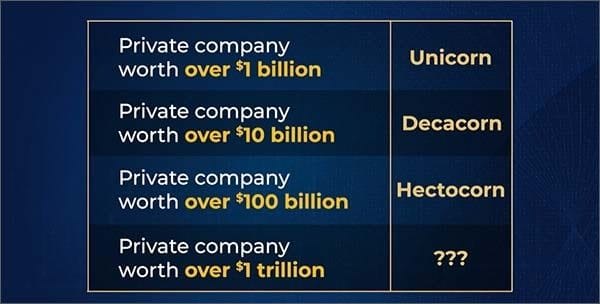
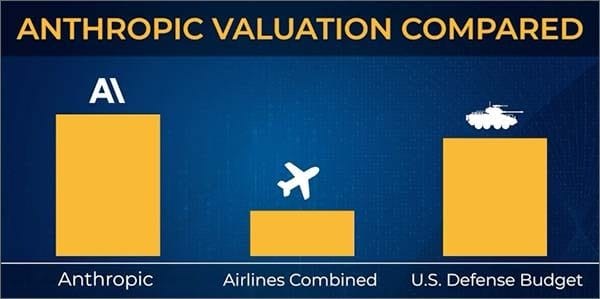
Anthropic is there, right now.
The first of its kind.
It's worth more than every American airline — combined.
It's even bigger than the U.S. defense budget…
Anthropic's annualized revenue grew by 80 times in the first quarter.
They've already filed the paperwork for an IPO…
Some estimates say they are going public as early as October.
Most analysts agree, it's going to happen sometime this fall at worst.
Now, here's what's really exciting…
You can get a stake in this company, right now.
Today.
Before it goes public.
And have an opportunity to cash in on day one of this IPO.
All the best,
Michael Robinson
Director of Tech Strategies
Weiss Ratings
The BS-Meter — Headlines vs. The Fine Print
The Headline: "RFK Jr. Is Being Unfairly Blamed for a Complex Public Health Problem"
The Fine Print: The timeline is not complex. MMR coverage was above 95% before RFK Jr.'s appointment. It fell below the herd immunity threshold after. An executive order made the vaccination protocol structurally harder to complete. Children died of a disease eliminated 26 years ago. The causal sequence has three steps, not thirty. The complexity framing is doing the work of diffusing accountability that the timeline assigns directly.
The Headline: "Shapiro Is Politicizing a Health Crisis by Refusing Federal Help"
The Fine Print: Shapiro's refusal is grounded in a public health logic: the agency offering assistance is the agency whose messaging undermined vaccination trust in the first place. Accepting HHS involvement in outbreak management while HHS continues to operate under the same leadership and messaging framework would send a contradictory signal to the exact population whose vaccination hesitancy needs to be reversed. The refusal is a credibility-management decision, not a political one.
The Headline: "Parents Have a Right to Choose — Vaccine Mandates Are Government Overreach"
The Fine Print: Individual choice and herd immunity are mathematically incompatible at measles' R0 of 12–18 when aggregate coverage falls below 93%. A parent's choice not to vaccinate their child does not affect only their child — it reduces the coverage rate that protects immunocompromised neighbors, infants too young to be vaccinated, and the small percentage of vaccinated individuals for whom the vaccine does not produce full immunity. The "individual choice" framing treats a collective immunity threshold as an individual decision. The epidemiology does not work that way.
Sponsored
Remember When Ring Got Rejected on Shark Tank?
And then Amazon turned around and bought it for $1.0 billion just a few years later?
Kevin O'Leary called it the worst mistake in Shark Tank history — a 67,756% return missed.
Now, a new smart home disruptor is following in Ring's footsteps, and you can get in early.
🚀Meet RYSE — the company transforming smart shades.
Big tech has tackled security (Ring), thermostats (Nest), and lighting (Hue)…
But they've completely missed one massive category: window shades.
RYSE's patented technology is filling the gap — transforming regular shades into smart shades without expensive replacements.
Think retrofit, not rip-and-replace.
Here's why investors are jumping in:
— $20M+ in revenue and 70% annual growth.
— 100+ retail locations across the US & Canada.
— 10+ fully granted patents protecting first-of-its-kind technology.
— Proven demand with a successful pilot at Fairmont Hotel in Quebec.
And while Ring and Nest sold for billions, RYSE is positioning itself for the same kind of outcome.
But Here's the Catch:
Shares are available at just $2.50 each — but not for long.
Over 4,000+ investors have already joined the mission to transform smart homes.
Don't Make the Same Mistake the Sharks Did.
Secure your shares now and get up to 50% bonus shares!
🔒 Last chance to invest at just $2.50 per share →
This is a paid advertisement for RYSE Inc. made pursuant to a Regulation A+ offering and involves risk, including the possible loss of principal. The valuation is set by the Company; there is currently no public market for the Company's Common Stock. Nasdaq ticker "$RYSS" has been reserved by RYSE; any potential listing is subject to future regulatory approval and market conditions. Past share-price appreciation does not guarantee future returns. SEC qualification does not constitute SEC approval of the merits.
The Backhaul Index: Tonight's Macro Indicators
💉 U.S. MMR Vaccination Coverage — Current
Historic Low — Below 95% in Multiple States
Measles herd immunity requires sustained 93–95% coverage. Some counties now below 85%. CDC confirms this is the lowest recorded national coverage level since tracking began.
📅 Years to Achieve Measles Elimination
26 Years (1974–2000)
Elimination declared by CDC in 2000. Required sustained 95%+ coverage for over two decades. Its return required approximately 18 months of policy-driven coverage erosion.
🦠 Measles Basic Reproduction Number (R0)
12–18 (Most Contagious Virus Known)
One infected person infects 12–18 others in an unvaccinated population. For comparison: COVID-19 original strain R0 was 2–3. Seasonal flu is 1.2–1.4. Measles requires near-universal immunity to stop transmission.
💰 Cost of Single Measles Hospitalization
$15,000–$200,000+
Standard hospitalization $15–40K. Encephalitis complication (1 in 1,000 cases) requires ICU care averaging $200K+. Outbreak-scale costs flow into insurance premiums, Medicaid budgets, and CPI healthcare components.
The Wire: Daily Topics & Analysis
The States That Have Already Loosened Vaccine Requirements Are Now Managing Outbreaks
Following HHS messaging shifts under RFK Jr., at least seven states moved to weaken or expand exemption categories for school vaccination requirements. In each case, the loosening of requirements preceded a measurable decline in local coverage rates, which preceded outbreak conditions. The pattern is consistent and geographically distributed — this is not a single-state anomaly. It is a national policy experiment with a clearly observable outcome. The states that maintained strict vaccination requirements have not reported outbreak conditions at the same severity.
Art's Take: This is a natural experiment with a control group. States that loosened requirements got outbreaks. States that held the line did not. In any other domain — financial regulation, food safety, structural engineering — that outcome would generate an immediate policy reversal. In public health politics, it is generating a messaging debate instead.
The MMR Split Order Creates a Three-Year Pediatric Schedule Problem
Pediatricians and family medicine physicians have reported significant patient confusion following the executive order on MMR separation. Parents who were on the existing combined schedule now face guidance ambiguity — whether their child's first combined MMR dose "counts" under the new framework, whether they need to restart the sequence, and what the new recommended timing intervals are. This confusion has caused some parents to delay second doses pending clarification, which has created a cohort of partially vaccinated children who are neither fully protected nor counted as unvaccinated in CDC coverage statistics. The coverage data the CDC is reporting may understate the true protection gap.
Art's Take: There is a category of child right now who has received one dose of a combined MMR, whose parents are waiting for guidance on whether the second dose should be the old formula or three separate injections, and who is currently sitting in the immunity gap between partial and full protection. The CDC numbers do not capture these kids. The actual exposure population is larger than the reported coverage data suggests.